The Story of Hatshepsut: Egypt’s Remarkable Female Pharaoh
The Story of Hatshepsut:
Egypt’s Remarkable Female
Pharaoh
Ancient Egypt is famous for its powerful pharaohs, magnificent temples, and mysterious tombs. Among its rulers, however, one woman stands out as particularly remarkable: Hatshepsut, one of the most successful female pharaohs in ancient Egyptian history.
At a time when kingship was traditionally associated with men, Hatshepsut managed to become the ruler of Egypt and maintain power for more than two decades. She transformed the country through ambitious building projects, expanded trade, and presented herself as a legitimate king of Egypt.
Her story is one of ambition, political intelligence, prosperity, and historical mystery.
Who Was Hatshepsut?
Hatshepsut was born around 1507 BC, during Egypt's 18th Dynasty.
She was the daughter of Pharaoh Thutmose I and Queen Ahmose. As a member of the royal family, she was raised within the Egyptian court and was closely connected to the traditional institutions of kingship.
Hatshepsut later married her half-brother Thutmose II, following a royal tradition intended to strengthen the legitimacy of the ruling family.
When Thutmose II died, his son, Thutmose III, was still very young.
Hatshepsut initially became regent, effectively governing Egypt on behalf of her young stepson.
But her political role eventually went much further.
She declared herself pharaoh.
How Did Hatshepsut
Become Pharaoh?
Hatshepsut's rise to power was unusual.
Egyptian kingship was traditionally male, but Hatshepsut developed a carefully constructed political and religious image that presented her rule as legitimate.
She adopted the traditional titles and symbols of a pharaoh and was frequently represented wearing the ceremonial clothing and regalia normally associated with male rulers.
This did not necessarily mean that Hatshepsut was attempting to hide that she was a woman.
Instead, she was using the established visual language of Egyptian kingship to communicate that she was the legitimate ruler of Egypt.
Inscriptions also presented her reign as divinely approved.
According to one famous narrative, the god Amun was portrayed as her divine father, reinforcing the idea that her position was supported by the gods.
Hatshepsut as a Female
King
Hatshepsut's reign challenges modern ideas about gender and leadership in ancient Egypt.
She was a woman ruling within a political system designed around male kingship, yet she successfully adopted the symbols and institutions of the pharaoh.
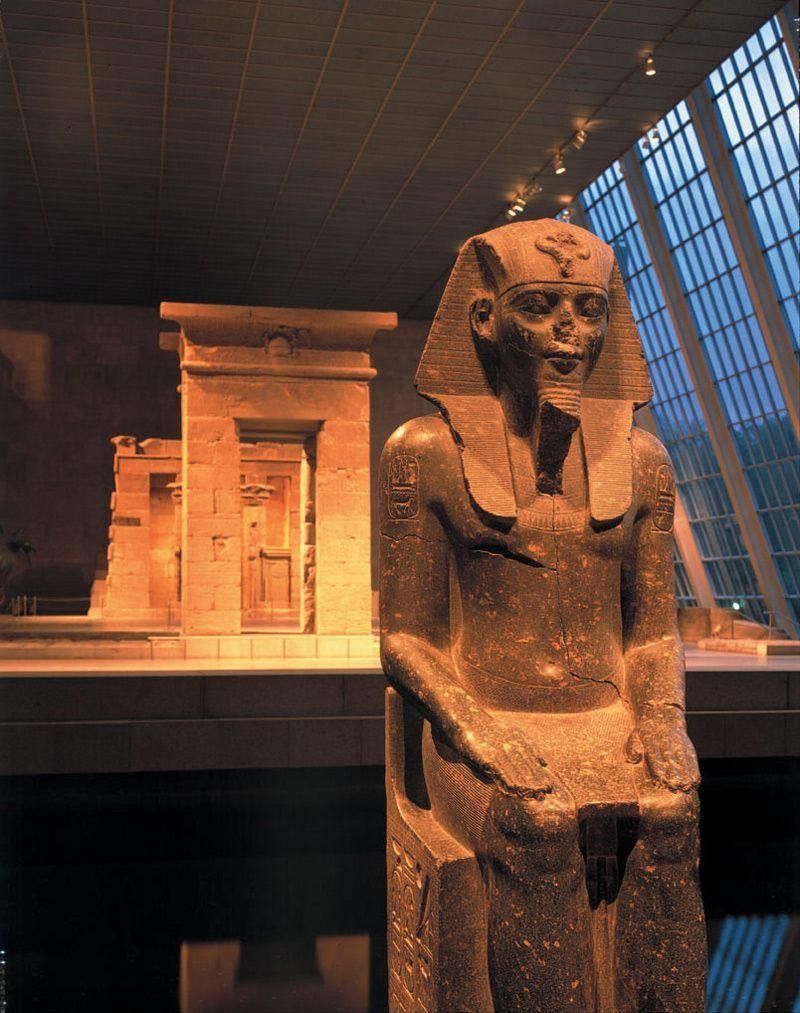
Some statues portray her with traditionally feminine features, while others show her wearing the traditional nemes headdress and ceremonial kilt of a male king.
She was sometimes depicted with the symbolic false beard associated with pharaohs.
These images were not simply portraits.
They were political statements.
They communicated that Hatshepsut possessed the authority and status of a traditional Egyptian king.
A Reign of Prosperity
Hatshepsut's reign was largely associated with stability and economic prosperity.
Rather than focusing primarily on military conquest, her government placed considerable emphasis on trade, construction, and economic development.
One of her most famous achievements was the expedition to the Land of Punt
.
The Expedition to Punt
The Land of Punt was a trading region known to the ancient Egyptians, although its exact location remains debated.
Hatshepsut organized a major expedition there, and the journey was recorded in remarkable detail on the walls of her mortuary temple.
The expedition brought back valuable goods, including:
- Frankincense
- Myrrh
- Exotic plants
- Precious woods
- Gold
- Animal products
The walls of Hatshepsut's temple show ships traveling to Punt, foreign rulers receiving the Egyptians, and exotic plants being brought back to Egypt.
The expedition demonstrated Hatshepsut's ability to organize large-scale international trade and strengthen Egypt's economy.
Hatshepsut's Greatest
Monument: Deir el-Bahari
Perhaps the most impressive surviving symbol of Hatshepsut's reign is her mortuary temple at Deir el-Bahari, near modern Luxor.
The temple is built into the dramatic cliffs on the western bank of the Nile.
Its architecture is striking because of its large terraces, long ramps, columns, and integration with the surrounding landscape.
The temple was designed by the architect Senenmut, one of Hatshepsut's most important officials.
Today, it is one of the most recognizable monuments on the West Bank of Luxor.
Visitors can still see reliefs depicting Hatshepsut's reign, including the famous expedition to Punt.
Senenmut: Hatshepsut's
Trusted Official
Senenmut was one of the most influential people in Hatshepsut's administration.
He held numerous positions and was closely involved in major construction projects.
His relationship with Hatshepsut has generated considerable speculation among historians and popular writers.
Some have suggested that they may have been romantically involved.
However, there is no definitive evidence proving that they had a romantic relationship.
What is clear is that Senenmut enjoyed considerable status during Hatshepsut's reign and played an important role in the construction of her monuments.
Hatshepsut and
Thutmose III
Hatshepsut's relationship with her stepson, Thutmose III, is another important part of her story.
Thutmose III was the rightful heir through his father, Thutmose II, but he was too young to rule independently when his father died.
Hatshepsut therefore governed as regent and later became pharaoh.
For many years, Hatshepsut and Thutmose III appear to have ruled within the same royal system.
After Hatshepsut's death, Thutmose III became one of ancient Egypt's greatest military rulers.
What Happened to
Hatshepsut?
Hatshepsut died around 1458 BC after ruling Egypt for roughly two decades.
Thutmose III then became the dominant ruler.
For many years, historians believed that Thutmose III had immediately attempted to erase Hatshepsut from history because he resented her taking the throne.
Her statues were destroyed, her name was removed from some monuments, and some of her images were deliberately altered or covered.
But the story is more complicated than a simple act of revenge.
Much of the damage occurred years after Hatshepsut's death, and scholars continue to debate the precise political motivations behind it.
One possibility is that Thutmose III wanted to restore a more conventional succession narrative in which his father was followed directly by him.
The Disappearance of
Hatshepsut
For centuries, Hatshepsut was largely forgotten.
Her monuments survived, but her identity and achievements were obscured.
Egyptologists eventually began reconstructing her story through inscriptions, statues, architecture, and archaeological discoveries.
One of the most important clues came from her monuments, where her name and titles could still be identified despite later attempts to remove them.
Her rediscovery transformed our understanding of ancient Egyptian history.
The Discovery of
Hatshepsut's Mummy
In 1903, archaeologist Howard Carter discovered a mummy in tomb KV60 in the Valley of the Kings.
For many years, its identity remained uncertain.
Later research connected a mummy discovered in another tomb, KV20, with Hatshepsut.
In 2007, Egyptian archaeologist Zahi Hawass and his team announced that a mummy found in the tomb KV60 had been identified as Hatshepsut.
The identification was supported by archaeological and scientific evidence, including comparison with royal family remains and a tooth found inside a box bearing Hatshepsut's name.
The discovery provided new information about the pharaoh's physical condition and final years.
Hatshepsut's Legacy
Hatshepsut's greatest legacy is not simply that she was a woman who became pharaoh.
She was an effective ruler who governed Egypt during a period of strength and prosperity.
Her reign demonstrated that political authority in ancient Egypt could sometimes operate outside the traditional expectations of male kingship.
She also left behind some of the most impressive architecture of the New Kingdom.
Her temple at Deir el-Bahari remains a powerful reminder of her reign, while the reliefs depicting the expedition to Punt provide valuable information about ancient Egyptian trade and international relationships.
Why Is Hatshepsut
Important Today?
Hatshepsut continues to fascinate historians, archaeologists, and visitors because her story combines power, politics, religion, architecture, and gender.
She lived in a society with strong traditions surrounding kingship, yet she successfully positioned herself at the center of Egyptian political and religious life.
Her story also reminds us that history is not always permanent.
A ruler can attempt to erase someone's name, but monuments, inscriptions, and archaeological evidence can eventually bring that person back into the historical record.
Hatshepsut disappeared from popular memory for centuries.
Today, she is recognized as one of ancient Egypt's most remarkable rulers.
Visiting Hatshepsut's
Temple Today
Travelers visiting Egypt can explore Hatshepsut's mortuary temple at Deir el-Bahari, located on the western side of Luxor.
The temple is particularly impressive because of its setting.
Huge limestone cliffs rise behind the terraces, creating a dramatic backdrop.
Visitors can explore the different levels of the temple, examine surviving reliefs, and learn about Hatshepsut's reign.
A visit to the temple is often combined with other major attractions on Luxor's West Bank, including the Valley of the Kings.
Fascinating Facts About
Hatshepsut
- Hatshepsut was one of the few women known to have ruled Egypt as pharaoh.
- She ruled during the 18th Dynasty of the New Kingdom.
- Her reign lasted for approximately two decades.
- She organized a famous trading expedition to Punt.
- Her mortuary temple was built at Deir el-Bahari.
- She was closely associated with the god Amun.
- Her monuments contain detailed scenes of trade and royal ceremonies.
- Her name and images were later removed or damaged in several monuments.
- Her historical identity was eventually reconstructed by Egyptologists.
- Her story remains one of the most fascinating chapters in ancient Egyptian history.
Final Thoughts
Hatshepsut's story is one of the most extraordinary stories from ancient Egypt.
She was born into royalty, became a queen, ruled as regent, and ultimately claimed the title of pharaoh.
Instead of defining her reign through constant warfare, she emphasized trade, construction, religion, and economic prosperity.
Her magnificent temple at Deir el-Bahari remains one of Egypt's architectural treasures, while the scenes of the expedition to Punt provide a remarkable window into the world of the New Kingdom.
Although later generations attempted to obscure her legacy, Hatshepsut could not be erased forever.
More than 3,000 years later, her name is once again known around the world.
Hatshepsut was not simply Egypt's famous female pharaoh. She was a powerful ruler whose ambition, political skill, and achievements secured her place in history.